

The Unsolved Mystery of Agatha Christie
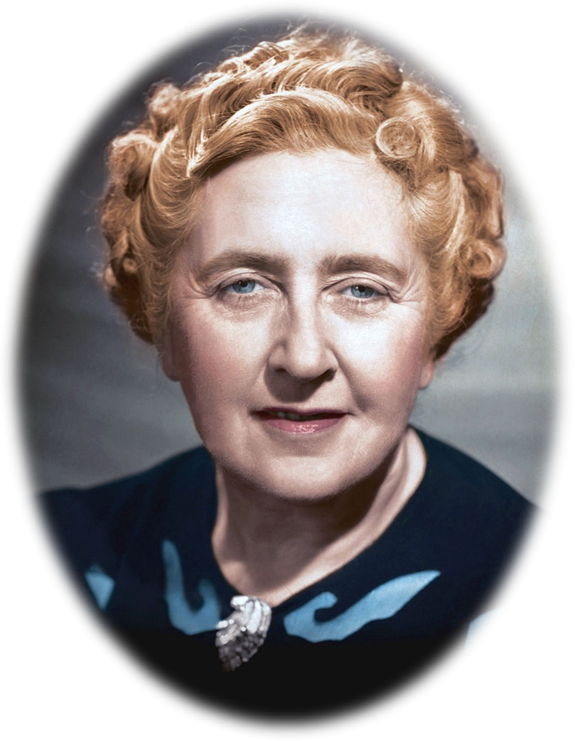
The Unsolved Mystery of Agatha Christie
“A train is speeding through the darkness. Suddenly it gets trapped in the snow. Twelve strangers sit silently inside. Then, suddenly, a terrifying scream echoes through the night.
A man is found dead in his locked compartment. The windows are sealed. No one could have escaped from the train. So, is the murderer still on the train? No one knows.
Is it the businessman? The princess? The professor? Or is it the person sitting quietly beside you?”
Agatha Christie’s genius comes alive in Murder on the Orient Express (1974), one of the most celebrated adaptations of her work. As the luxurious train remains completely stuck and motionless in the snow, detective Hercule Poirot is faced with a baffling murder: He begins questioning the passengers; every answer creates another question, and every clue seems to hide a darker secret. Every passenger could be the culprit, yet every passenger seems to have an alibi. With each clue, suspicion shifts, secrets emerge, and the truth becomes more elusive.
This is the chilling world of Agatha Christie, a perfect setting for a mystery by the legendary “Queen of Mystery,” whose stories have kept millions of readers guessing, suspecting, and doubting until the very last page.
Biographers, publishers, and fans frequently call her the “Queen of Mystery” and “Queen of Crime” to describe her legacy.
Christie transformed ordinary people, hidden motives, and seemingly impossible crimes into stories that have captivated readers for generations.
As we remember Agatha Christie on her birthday, 15 September, it seems fitting to celebrate the woman who turned mystery into an art. Her stories continue to intrigue, surprise, and challenge us decades after they were written. So, on this occasion, let’s revisit the life and legacy of the “Queen of Mystery” and perhaps, along the way, we may uncover a few clues to the greatest mystery of all: Agatha Christie herself.
Agatha Mary Clarissa Miller was born to Clara and Frederick Miller in an affluent family, on 15 September 1890, in Torquay, Devon. She was the youngest of their three children. Her father died, when she was eleven years old and the family fell into severe financial difficulties. Their unstable economic situation resulted in her being sent to a formal girls' school in Torquay. Later, she completed her studies in piano and vocals in Paris.
In 1912, Agatha met and fell in love with Archie Christie, a British military officer and businessman. He was sent to France during World War I and she joined a Voluntary Aid Detachment (VAD). They married in 1914 when Archie returned on leave.
During the war, she was stationed at a temporary military hospital where she cared for the wounded soldiers and assisted in surgeries. The character of Hercule Poirot, the Belgian detective of her novels, is believed to be inspired by the Belgian refugees. After working there for some time, she was transferred to the dispensary where she learned the chemistry of poisons. Here, she first conceived the idea of writing a detective story. Encouraged by her sister Margaret, she wrote her first detective novel, The Mysterious Affair at Styles which was Published in 1920. The use of poisons in her books are heavily inspired from her routine work with these lethal chemicals and medicines.
The transition from hospital nurse to dispensary assistant during World War I laid the foundation for her legendary writing career.
Though it’s difficult to quote the exact number of Agatha Christie's works, it’s widely believed that she has 130 major publications: 66 detective or crime novels.
Beyond her 66 detective novels, Christie's astonishing creative output includes 15 short story collections with 164 individual mysteries, 16 original stage plays, seven broadcast dramas written exclusively for the BBC, two autobiographical works, and two volumes of poetry.
She was a successful playwright. Mousetrap, one of her stage plays, is known to be the world’s longest running play. Yet, Agatha is best known for the 66 detective novels and 14 collections of short stories written under her married name ‘Christie’.
Her plots, mostly of the detective or crime novels, revolve round one or more characters lying and someone being murdered or found dead. Each mystery draws the reader deeper into a maze where the smallest detail may conceal the truth. The murders committed are very innovative and carefully staged. But her brilliant detective characters like Poirot’s masterful and precise deduction and Miss Marple’s village wisdom in the darker games of revenge and deception successfully bring the mysteries to an end.
Underneath these puzzling murders lies a dark fascination with human nature. Their greed, jealousy, betrayal, revenge, desires and secrets that makes people kill are all the backdrops of her novels. She repeatedly explores the uneasy boundary between appearances and reality, making the reader question even our closest relationships. Her novels make us realise that beneath the manners of respectable society, the oldest motives like love, money, fear and hatred still govern most of the people’s lives.
Many of her novels have been adapted more than once for movies and television. Some adaptations have been extensively modified versions. So, it’s difficult to count the novels that have made their way into films.
Some of her movies for their critical acclaim, iconic performances, and cinematic impact are: The ABC Murders (1963), Death on the Nile (1937), Appointment with Death (1938), And Then There Were None (1939), Evil Under the Sun (1941), Crooked House (1949), The Mirror Crack'd from Side to Side (1962), Murder at the Gallop(1963), Murder Most Foul (1964), Murder Ahoy (1964), Murder on the Orient Express (1934)… and the list goes on.
Murder on the Orient Express (1974) is one of the widely watched movies and regarded as one of the most famous and successful film adaptations of Agatha Christie's work. It’s directed by Sidney Lumet and earned six Oscar nominations and won one.
During 1930-1956, Agatha Christie hid her identity under the pseudonym Mary Westmacott to get away from the reader’s expectations of detective fictions from her and published six romantic fiction novels. In these intimate stories of love, she delved into the mysteries of human heart. All six portray a deep understanding of the fragile landscapes of the inner self.
Rosalind, her daughter, described these novels as deeply emotional tales of passion, exploring the dual nature of love: an intense force capable of acting as both a beautiful protector and a terrible devastating, ruinous obsessive force.
Giant’s Bread (1930) is the first one of these novels.
Unfinished Portrait (1934) is widely recognized as Christie's deeply semi-autobiographical novel, mirroring the real-life grief, marital breakdown, and psychological trauma that she faced leading to her famous 1926 disappearance.
Critics consider Absent in the Spring (1944) as the finest of her six non-mystery novels. It was followed by The Rose and the Yew Tree (1947),
When the secret of her identity finally leaked in 1949, the reaction from critics and the public was a mix of shock, intense fascination, and a major re-evaluation of Agatha Christie’s literary talents. A Daughter’s a Daughter (1952) and The Burden (1956) were written after her identity was revealed.
She also teamed up with fellow British mystery authors to co-write three mystery projects.
Behind the Screen (1930), is a collaborative detective serial originally written for weekly radio broadcasts on the BBC National Programme. Following its success, the same core group of Detection Club members teamed up for another BBC radio serial The Scoop (1931). The most famous of the club is a full-length mystery novel The Floating Admiral (1931), which features contributions from 12 distinct British authors. Each writer took turns writing a chapter without knowing how the previous authors intended to solve the crime.
A few among many of her darkest and most psychologically chilling works are: And There Were None (1939), Crooked House (1949), The Pale Horse (1961), Endless Night (1967).
Among Christie's most celebrated characters is Hercule Poirot, a brilliant Belgian detective renowned for his meticulous logic. He is exceptionally observant and relies heavily on psychology and understands human nature. He is proud, precise and particular about order, symmetry and personal appearance. Despite his vanity and occasional eccentricity, he possesses a strong sense of justice and compassion. Perhaps even more famous than Poirot himself, is his moustache, with a character of its own. Luxurious, magnificent, immense, and dedicatedly groomed, the moustache precedes Poirot into a room. Poirot’s character is featured in 33 of her novels.
Miss Jane Marple is a gentle-looking elderly spinster whose sharp mind is easily underestimated. She solves crimes by drawing upon her profound understanding of human nature and the darker side of village life. Quiet, observant and deceptively shrewd, she often notices what others overlook and solves crimes that often baffle the police.
Agatha Christie’s novels consist of six very interesting detective characters with their particular traits. Poirot, Miss Marple, Tommy & Tuppence and Ariadne Oliver appear in novels, while Harley Quin and Parker Pyne are principally short-story characters.
Interestingly, Agatha Christie’s own life is shrouded in just as much mystery as her fictions.
After the war, Agatha and Archie moved to London. She secured a publishing contract for her debut novel, The Mysterious Affair at Styles 1919, though it was written in 1916. The family moved to a home in Berkshire named Styles after her first novel. Despite her growing wealth, Agatha was careful and modest in spending money. Possibly, as a result of the financial insecurity in her childhood following her father's death. Her strict approach to finances reportedly contributed to tensions in her marriage. Those were further complicated by Archie's affair with his secretary, Nancy Neele.
Agatha’s mother passed away in April 1926. Her death was a devastating blow to Christie, as her mother was her closest confidante. It was a period of immense personal trauma for her.
On December 3, 1926, Agatha and her husband, Archie Christie, had a bitter argument after he confessed to having an affair and asked for a divorce. After the argument, Archie left home to spend a weekend away with friends and his mistress. Agatha is then said to have left her daughter with their maid and drove away in her green Morris Cowley, and vanished. This was the beginning of one of the most timeless mysteries she had ever masterminded.
The next morning her car was found abandoned several miles away by Surrey Police, partly submerged in bushes at Newlands Corner in Guildford, Surrey. It looked like a car accident. The headlights were still on. A suitcase and coat sat untouched in the back seat. But the driver was gone, leaving behind nothing but an expired license. What they found only fuelled the mystery. The disappearance became front-page news and turned the case into a national sensation in England and triggered a massive manhunt for the celebrated writer.
Hundreds of police officers, thousands of volunteers, and even airplanes were used to search the countryside and the nearby bodies of water.
As the police kept searching, the circumstances led to intense speculation, with theories spanning from a deliberate vanishing or emotional breakdown to far more sinister possibilities.
Theories ranged from tragic suicide, murder by her husband, or a clever marketing stunt to boost her book sales. Even Sir Arthur Conan Doyle joined the hunt, bringing one of Christie's gloves to a psychic to help crack the case
The mystery ended 11 days after her disappearance on December 14, 1926 almost as dramatically as one of her novels. She had registered at the Swan Hydropathic Hotel in Harrogate, Yorkshire, under the name “Teresa Neele”, deliberately using the surname of Archie’s mistress.
She was recognised by Bob Tappin, a banjo player in the hotel's resident band. He informed the police that a South African guest by the name of Teresa Neele may actually be the missing writer in disguise, and claimed a reward for finding her.
What followed could have been a scene from one of her novels.
Archie travelled with the police to Yorkshire and took a seat in the corner of the hotel’s dining room. He watched Agatha walk in calmly and sit at another table. She began reading a newspaper which had her own disappearance as front-page news. When he approached her, apparently, she didn’t recognize him and stared blankly at him. The revelation brought an extraordinary disappearance to a close. But it also created a mystery that has never been completely solved.
The couple officially separated shortly after this and finalised their divorce in 1928. Archie married Nancy Neele in October, when his divorce decree from Agatha Christie was settled.
Two years later, in September 1930, she met and married archaeologist Max Mallowan. She was 39 and he was 25 years old. Despite the 14-year gap, they shared a deeply compatible partnership. They remained happily married for 46 years until her death in 1976.
The legendary “Queen of Crime” left behind a world captivated by her final, unwritten departure. She was then laid to rest in the quiet earth of Cholsey, finding her own eternal peace beneath the stones of the Church of St Mary.
The question remains: What happened during those missing days?
Though she attributed the entire ordeal to amnesia and a nervous breakdown, Agatha Christie never publicly discussed the event or mentioned it in her autobiography. She preferred to leave the true details private. This silence only deepened the mystery, leaving the circumstances of her disappearance open to speculation.
Historians and biographers believe Christie had a severe nervous breakdown caused by the heartbreak of losing her mother and her husband’s betrayal.
Whether she intended to disappear, was suffering from severe emotional turmoil, or simply sought escape from the crisis surrounding her, the truth remains obscured, leaving behind an unsettling real-life mystery from the woman who made mystery her art.
The greatest mystery Agatha Christie ever left behind was not in one of her books, but in her own life. Although she returned, her disappearance for eleven days has left behind questions that have never been completely answered.
Perhaps that is the ultimate triumph for the “Queen of Mystery” herself, because even after a century of hunting, we still search for clues.
Agatha Christie has left us with one final unsolved case: her own.