

The Global Journey of Syed Manzoorul Islam
The Global Journey of Syed Manzoorul Islam
Tasneem Hossain
Some writers' words travel because the world is already waiting for them. And some writers spend a lifetime building the roads along which words may travel.
Professor Syed Manzoorul Islam belonged, in many ways, to the second kind.
He occupies a vital place in contemporary Bangladeshi literature. A rare and influential voice, he breathed new life into modern fiction by seamlessly blending postmodern narrative techniques, magical realism, and incisive satire to challenge conventional modes of storytelling.
Though a celebrated professor of English at the University of Dhaka, Islam chose Bengali as the primary home for his creative voice. Through this deep linguistic connection, he structurally reshaped local folk traditions and vastly expanded the possibilities of contemporary Bengali literature.
Born in Sylhet, Islam grew up immersed in local oral storytelling and regional dialects, while his education introduced him early to Western literature. Later, as an academic focusing on modernism and postmodernism, he used advanced Western literary theory to structurally reshape those rich folk traditions. Though his creative voice remained deeply rooted in Bengali, the language of memory and emotion, this unique dual environment allowed him to move naturally between both worlds.
Together, these two worlds enabled him to reshape modern Bengali fiction through the lens of Western literary theory.
Islam began his literary journey by writing a few poems. However, he quickly realized poetry was not his true calling and shifted his focus to fiction.
He gained recognition in 1973 with his Bengali short story ‘Bishal Mrittu’ in Bichitra. Later, he took a nearly 15-year break to pursue his academic career and PhD at Queen’s University, Canada. During this time, he studied Western literary theory, aesthetics, and world literature. He returned to Bengali fiction in 1989 through Bichinta, marking the beginning of his prolific literary career.
Over time, Islam’s creative output expanded significantly. His literary journey evolved from localized short stories to expansive novels, art criticism, and ecological writing. In his later career, Islam pioneered Bangladeshi eco-fiction, using magic realism to critique capitalism and environmental destruction, notably in Shakuner Dana (2013). He also became a prominent art critic and essayist, and received the Ekushey Padak in 2018 for his contribution to Bengali literature.
Bengali was undeniably the true home of his creative voice. His literary imagination drew deep inspiration from Bangladesh, finding form within its cities, villages, myths, memories, history, people, and language. Yet, his intellectual life continually crossed borders. He wrote in Bengali and English, translated Bengali poetry, carried Bangladeshi fiction into international literary spaces, participated in conversations on world literature, curated Bangladeshi art abroad, and engaged with readers, writers, scholars, artists and translators far beyond Bangladesh.
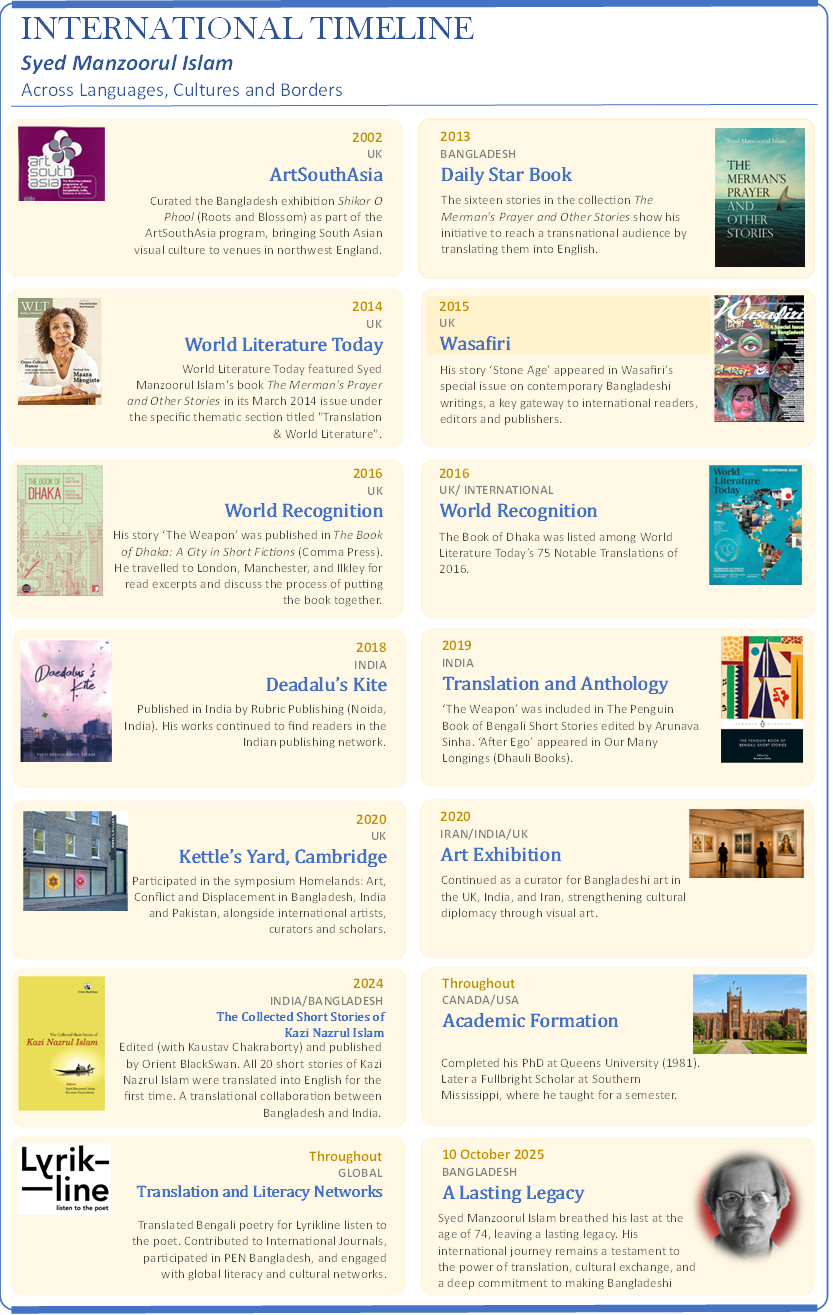
Islam’s international journey therefore cannot be measured simply by the number of countries in which his books appeared. It is better understood as a journey of translation, exchange and mediation: a movement between languages, cultures and ways of seeing.
Syed Manzoorul Islam passed away at the age of 74 on 10 October 2025 leaving a great void behind.
Today, as we honor his first death anniversary, perhaps the most revealing question we can ask is not simply what he wrote, but rather: How far did his literary imagination travel, and how far did he help Bangladeshi literature travel with him?
Internationally, one of the most distinctive things about him was his relationship with language. Comma Press, the British publisher, described him as a bilingual author who wrote with unusual ease in both Bengali and English. His first English-language collection, The Merman's Prayer and Other Stories, appeared in The Daily Star Books in 2013. The collection was particularly significant because it featured 17 of his self-translated stories into English.
That act of self-translation was more than a linguistic exercise. It became part of his larger literary identity.
In Bengali, Islam belonged to the rich and complex tradition of contemporary Bengali fiction. In English, he could enter a different literary conversation without abandoning the imaginative world from which his stories emerged. This dual position attracted international scholarly attention.
In 2014, World Literature Today, published by the University of Oklahoma, featured his work in its section on “Translation & World Literature” and published a conversation with him on self-translation. The same journal also reviewed The Merman's Prayer and Other Stories, drawing attention to the unusual combination of surrealism, irony, humour and Bengali oral narrative traditions in this fiction.
For a Bangladeshi writer, this was significant. Islam was no longer simply being presented as an author from another country. His work was being discussed within the international intellectual framework of world literature and translation.
2015: Bangladesh enters Wasafiri
Another important milestone came through Wasafiri, the influential UK literary magazine associated with international and postcolonial writing. Its 2015 special issue on Bangladesh included Islam's story “Stone Age.” The issue was devoted specifically to contemporary Bangladeshi writing and brought together fiction, poetry, criticism and interviews.
International literary journals are often gateways through which writers become visible to editors, translators, publishers, critics and readers beyond their own countries. Islam, later, recalled that the publication of one of his stories in Wasafiri led to approaches from other publishers interested in translations, resulting in a major literary travel.
Islam’s story crossed a language boundary; the story attracted international attention; the attention paved way for another translation, another publisher, another reader.
The journey began to multiply.
2016: Dhaka enters the British literary world
The Book of Dhaka: A City in Short Fiction (2016), published by the British independent publisher Comma Press and Bengal Lights Books, was a major milestone in bringing contemporary Bangladeshi fiction to British and global English-speaking audiences. It featured ten leading Bangladeshi writers, including Syed Manzoorul Islam’s, “The Weapon”. The anthology emerged from an international translation project supported by organisations such as Commonwealth Writers, English PEN, and the British Centre for Literary Translation. The book was subsequently recognised by World Literature Today as one of its 75 Notable Translations of 2016.
The Book of Dhaka challenged stereotypical Western portrayals of Bangladesh by presenting Dhaka as a vibrant, complex city and demonstrating the global appeal of Bangladeshi postmodern and magic-realist fiction.
The story did not end only with publication. In October 2016, Islam travelled to Britain with editor and translator Pushpita Alam for events in London, Manchester and Ilkley. He participated in discussions about Dhaka, the making of the anthology and the process of translation, and read from his story, “The Weapon.”
A remarkable achievement indeed, where his international visibility was not confined to a bibliographical entry in a foreign catalogue. He was physically present in the literary spaces where translation was being discussed, explaining Bangladesh and its literature to audiences outside the country.
The English translations of Absurd Night (Ajgubi Raat) and the short story ‘Woodworms’ (Kathpoka) published in 2019 appeared in international anthologies, helping bring Bangladeshi fiction to wider global and academic audiences. Some other short stories, translated prose, and curations have appeared in various Western and transnational anthologies, establishing him as a crucial voice in postcolonial literature.
Beyond fiction: translating Bengali poetry
Islam also partnered with American poet and translator Carolyne Wright to build comprehensive Western anthologies featuring modern West Bengali and Bangladeshi women poets (such as Shamim Azad). He served as the cultural translator, explaining intricate local nuances to provide the cultural context needed to make these nuances accessible to English readers. Carolyne Wright valued him as a highly skilled cultural translator who could preserve the meaning, emotion, tone, and cultural flavour of Bengali rather than translating literally.
He also contributed a major critical introduction to Ballads from Bangladesh: An Anthology of Poems (2009), which was distributed globally to introduce Western libraries and universities to the lyrical and historical trajectories of Bangladeshi poetry. These further strengthened the cultural bridges and gained wide international recognition.
The international poetry platform Lyrikline records Syed Manzoorul Islam as the English translator of four poems by Bangladeshi poet Sajjad Sharif. Among them are “Beauty and the Beast,” “The Blind Hunter,” “The Neighbour” and “The Tree Found on the Moon.”
This is an important part of his legacy.
Translation is often described as the movement of one writer's work into another language. But translators also act as cultural bridges. By translating Bengali poetry for an international platform, he helped another Bangladeshi literary voice enter an English-language environment.
His international role therefore had two directions: his own literature travelled outward, and he helped the literature of others travel outward.
What made Islam’s writing more significant and garnered international attention was the way he translated the Bengali works. He rejected Westernization of the Bengali language to preserve the cultural identity and social realities of the original text. He believed Bengali literature should not be altered to fit Western expectations because the two languages represent entirely different social realities and trying to westernize the Bengali text erodes the global south identity.
He also preserved the cultural Identity by supporting foreignization, keeping culturally specific Bengali words, foods, titles, and expressions in the English translation. This allowed English-speaking readers to experience Bangladeshi culture on its own terms.
Moreover, he tried to preserve the natural, conversational warmth, spontaneity and sometimes non-linear rhythms of Banglaadda into his English prose rather than making them artificially formal or Westernized.
For him, translation was a creative process rather than word-for-word copying and believed that the translator could reshape language and structure to preserve the original work’s emotions, meaning, and cultural experience. Emancipated by this artistic freedom, he empowered himself to reshape syntax and dialogue in order to authentically convey the Bangladeshi experience across borders, as is seen in The Merman’s Prayer and Other Stories. Rather than translating Bengali literally, he used transcreation, recreating idioms, folk metaphors, dialects, and cultural references in natural English while preserving their original emotion and cultural identity.
Art without borders
Literature, however, was only one part of Islam’s international cultural life. He was also an influential art critic and curator. British and international sources record his involvement in presenting Bangladeshi art abroad, including exhibitions in the United Kingdom, India and Iran.
One particularly significant example came in 2002, when the ArtSouthAsia programme presented visual culture from Bangladesh, India, Pakistan and Sri Lanka at venues in northwest England. The Bangladesh exhibition, Shikor O Phool (Roots and Blossom), was curated by Professor Syed Manzoorul Islam.
The programme described itself as an international presentation of visual culture from South Asia. For him, this represented another way of carrying Bangladesh beyond its geographical boundaries not through fiction this time, but through painting, visual culture and artistic interpretation.
Islam’s international identity is, therefore, broader than that of a novelist or short-story writer.
He became a cultural interpreter of Bangladesh.
In January 2020, this role became visible again at Kettle's Yard, University of Cambridge, during the symposium ‘Homelands: Art, Conflict and Displacement in Bangladesh, India and Pakistan.’
The symposium brought together artists, curators, researchers and scholars examining questions of migration, displacement, partition, national identity and the idea of home. Islam was among the participants, alongside internationally recognised figures in South Asian art and cultural studies.
The setting is significant. Cambridge is one of the world's major centres of scholarship. The discussion was not simply about ‘Bangladeshi art’ as an isolated national subject. Bangladesh was being considered within larger questions of history, migration, identity, conflict and the movement of people and cultures across borders.
He spent his career crossing disciplinary boundaries: literature and criticism, fiction and translation, language and visual culture, Bangladesh and the wider world.
Perhaps one of the most fitting examples of his international work came near the end of his life.
In 2024, Syed Manzoorul Islam and Kaustav Chakraborty edited The Collected Short Stories of Kazi Nazrul Islam, published by Orient BlackSwan in India. This anthology brought all 20 of the iconic ‘Rebel Poet's’ short stories into the English-speaking world for the first time. It was explicitly described by the publisher as a transnational collaboration involving Bangladesh and India.
Here again, he was not merely presenting himself to the English-reading world, but helping one of the foundational voices of Bengali literature cross the language barrier. He had spent decades to showcase Bangladeshi literature globally. Near the end of his life, he was helping make one of Bengal's most important literary figures available to English readers.
The paradox of global visibility
Yet there is a fascinating paradox in Professor Syed Manzoorul Islam's international journey. He was himself conscious of the limitations of Bangladesh's presence in international English-language literature. In a scholarly discussion of world literature, he observed that South Asian literature in English was dominated by India, whose writers benefited from established publishing networks, international connections, markets and literary prizes. Bangladesh, he suggested, possessed talent but was still developing the infrastructure required for comparable international visibility.
His observation remains important because it prevents us from romanticising the idea of “global recognition.”
Syed Manzoorul Islam was internationally visible. His stories appeared in international journals and anthologies. His English fiction was reviewed internationally. His work entered world-literature discussions. He participated in literary events in Britain. His translations appeared on international platforms. He engaged with Cambridge and other international academic and cultural networks. His art criticism and curatorial work took Bangladeshi visual culture abroad.
But these achievements also revealed the larger challenges that he identified. One Bangladeshi writer crossing borders does not automatically mean that Bangladeshi literature has achieved a sustained global presence.
Perhaps this is why his own career matters beyond his individual literary achievement.
He was not only a traveller across literary borders. He was helping to build bridges between worlds.
Syed Manzoorul Islam's international legacy may therefore be understood through four words: Writing. Translation. Interpretation. Exchange.
He wrote Bengali literature that could speak to English readers.
He translated Bengali voices into English.
He interpreted Bangladeshi art and culture for audiences abroad.
And he participated in conversations in which Bangladesh was not a distant footnote but part of a larger discussion about literature, modernity, migration, identity and culture.
His international journey offers us a lesson for the future. For Bangladeshi literature to become more visible internationally, writers need translators; translators need publishers; publishers need readers; readers need access; and literature needs institutions willing to carry it across linguistic and cultural boundaries.
Islam understood this ecosystem. Perhaps that is why his international legacy cannot be measured simply by a list of foreign publications. His deeper contribution was to demonstrate that Bengali literature need not become less Bangladeshi in order to become international. It could travel precisely because it carried its own landscape, language, memory and imagination with it.
A Dhaka street could enter a British anthology. A Bengali poem could appear in an international digital poetry archive. Bangladeshi art could be discussed in England. Nazrul's stories could reach English readers through a transnational publishing project. And a Bangladeshi literary scholar could sit in Cambridge and participate in a global conversation about home, displacement and identity.
Those were not departures from Bangladesh. Those were different ways of taking Bangladesh Beyond borders and establish it globally.
A year after his death, perhaps the most fitting way to remember him is therefore not to imagine him as a writer who left one literary world for another. He belonged to both.
His work reminds us that literature does not really travel by abandoning its home. It travels through translation, curiosity and human connection. And perhaps that is where his international legacy finally rests: not in how famous his name became beyond Bangladesh, but in how many doors he helped open between Bangladesh and the world.
The journey he began is not finished. There are still stories to translate, poems to carry across languages, artists to introduce, readers to reach and literary borders to cross.